
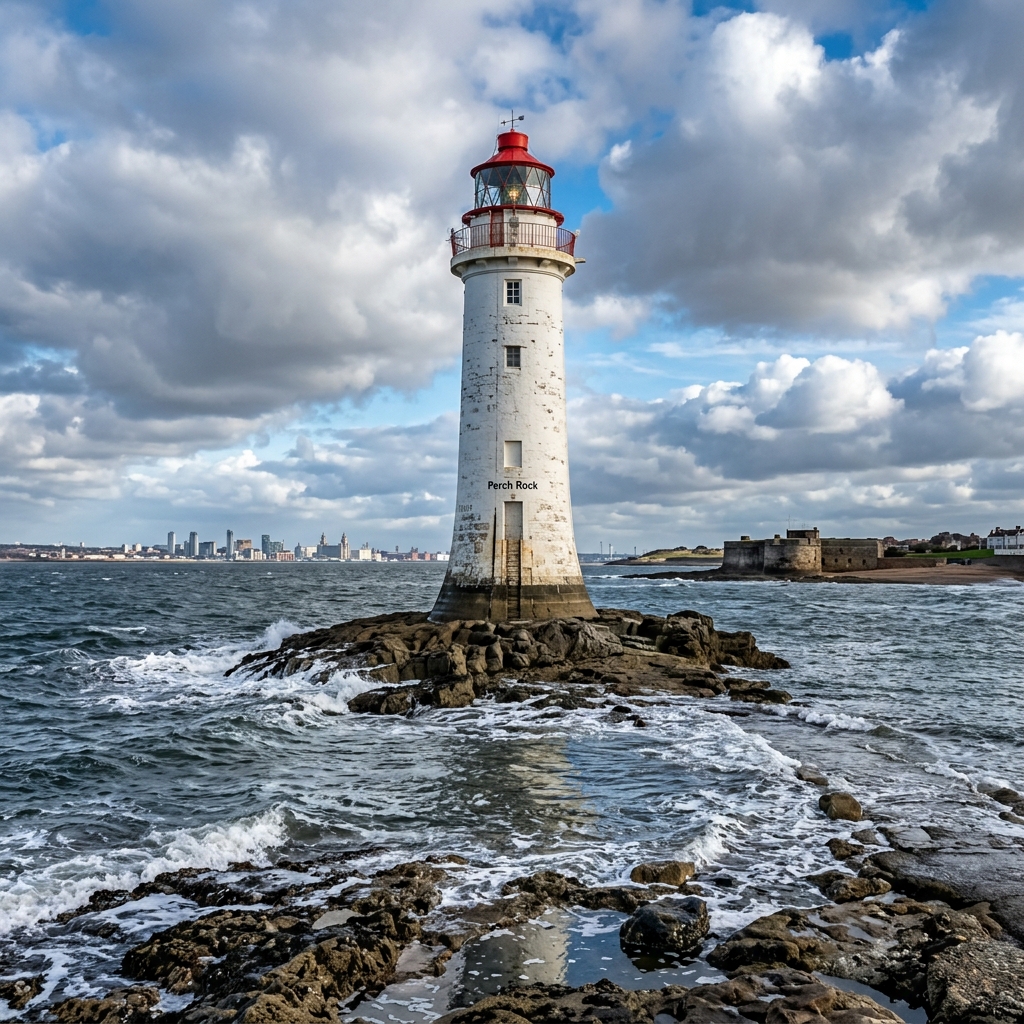
Standing resolute against the crashing waves of the Irish Sea at the mouth of the River Mersey, Perch Rock Lighthouse is arguably the most iconic landmark on the New Brighton coastline. Its stark white stone and brilliant red lantern room make it a photographer's dream, but the lighthouse is much more than just a picturesque backdrop; it is a vital piece of Britain's maritime heritage.
Before the Stone: The Original "Perch" (1683–1827)
To understand the lighthouse, we must first look at the treacherous waters it was built to protect. The approach to the Port of Liverpool was notoriously difficult, characterized by shifting sandbanks and the dangerous "Black Rock" outcrop near the Wirral shore.
The name "Perch Rock" is not accidental. Long before the stone tower was erected, the site was marked by a primitive wooden tripod—a literal "perch"—which supported a simple iron basket containing a warning light. This original structure was established as far back as 1683. However, this wooden perch was continually battered by the relentless sea, requiring constant repairs and frequently being washed away entirely during heavy winter storms.
As Liverpool’s global dominance in shipping exploded during the 19th century, relying on a fragile wooden tripod to protect immensely valuable cargo ships became unacceptable. A permanent solution was desperately needed.
An Engineering Marvel (1827–1830)
In 1827, Liverpool Corporation commissioned a robust, permanent stone lighthouse to replace the wooden perch. The project was designed and overseen by the renowned architect John Foster Jr.
"The construction of Perch Rock Lighthouse was a masterclass in early 19th-century coastal engineering, drawing heavily on techniques proven against the harshest maritime conditions."
Construction was a monumental task, heavily influenced by the groundbreaking engineering used by John Smeaton for the famous Eddystone Lighthouse. The tower was built using interlocking blocks of granite, meticulously quarried from Anglesey—the very same resilient stone used for Thomas Telford's magnificent Menai Suspension Bridge.
To ensure the structure could withstand the immense, direct force of the crashing waves, the blocks were secured using dovetail joints and a specialized, highly durable "Puzzellani" cement, derived from volcanic ash. At its base, the walls of the lighthouse are an incredible six feet thick, tapering gracefully as the tower rises 90 feet into the air. Construction was officially completed, and the light was first lit, on March 1, 1830.
Evolution of the Light
For decades, the lighthouse was manned by dedicated keepers who lived in cramped conditions inside the tower, enduring howling gales and isolation just a stone's throw from the bustling promenade.
Originally, the beacon utilized a system of argand lamps and highly polished silver reflectors to cast a fixed white light out to sea. In 1858, as technology progressed, this system was upgraded to a modern dioptric lens system, which significantly increased the range and visibility of the light. Eventually, the lighthouse was automated, adopting a characteristic flashing pattern that allowed mariners to easily identify their position in zero-visibility weather.
Decommissioning and Modern Legacy
Perch Rock Lighthouse stood as an active, vital navigational aid for over 140 continuous years. However, by the late 20th century, the advent of advanced radar, GPS, and modern navigational technology meant that traditional coastal lighthouses were becoming obsolete.
The lighthouse was officially decommissioned on October 1, 1973. Following its retirement, the building was sold into private ownership. Today, it is recognized as a Grade II* listed building, cementing its status as a site of significant national and architectural importance.
While it no longer guides massive merchant ships into port, Perch Rock Lighthouse remains the proud symbol of New Brighton. Thanks to restoration efforts, modern LED lighting systems have occasionally been installed, allowing the lighthouse to be lit for commemorative events—including spelling out the names of those lost at sea in Morse code.
Next time you walk along the sands of New Brighton Beach and see the lighthouse standing against the horizon, take a moment to appreciate the incredible engineering and the countless lives this stoic sentinel has saved over nearly two centuries.